
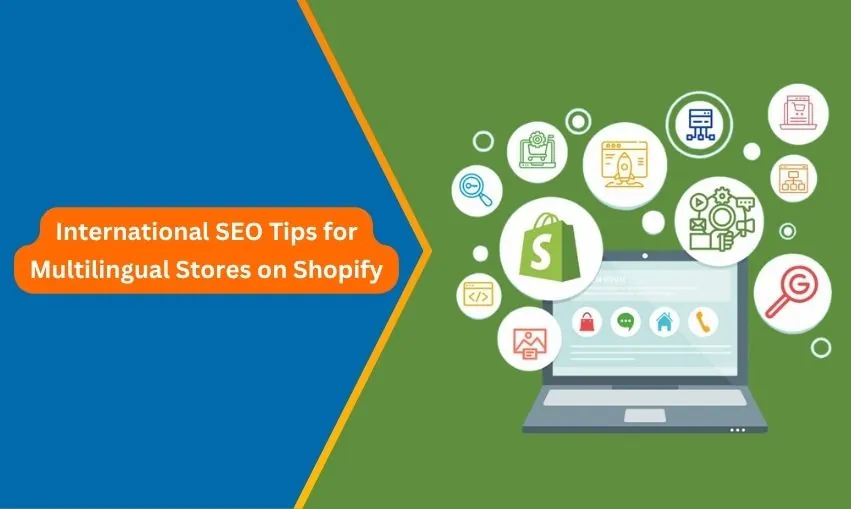
Are you running a Shopify store and wondering why your international traffic just isn’t picking up, even though your products are great and your ads are running? You’re not alone. Many store owners invest heavily in design and paid campaigns. But they overlook the one thing that makes global growth sustainable: international SEO for Shopify.
Here’s a number that puts it in perspective: over 75% of internet users make purchases in their native language, according to CSA Research. Yet most Shopify stores default to English-only content, leaving a massive figure of potential revenue completely invisible to international buyers. When your store isn’t optimized for multilingual SEO Shopify best practices, search engines simply can’t understand who your content is for and as a result, shoppers can’t find you.
The good news? With the right structure and strategy, your Shopify store can rank across multiple regions and languages without rebuilding everything from scratch. Not sure where to start? Keep scrolling to find out.

See How Our Experts Can Drive More Traffic to Your Website!
SEO: Boost your rankings and drive more organic traffic today!
Website Design/Development: Create a stunning website that converts visitors into customers.
Paid Media: Reach the right audience at the right time with expertly managed paid media.
Proven Strategies for International SEO on Your Shopify Store
Wondering how to employ Shopify international SEO in the right way? To help you out, here we have compiled the proven strategies. Work through them for the strongest result.
1. Set Up the Right URL Structure From the Start
Before you write a single word of translated content, your URL structure needs to be right. This is the backbone of SEO for multilingual ecommerce websites, and getting it wrong early creates technical debt that is difficult to undo.
Here’s a quick comparison of Subdirectories vs. Subdomains vs. ccTLDs
| Structure | Example | SEO Benefit | Best For |
|---|---|---|---|
| Subdirectory | yourstore.com/fr/ | Assures domain authority | Most Shopify stores |
| Subdomain | fr.yourstore.com | Easy to set up | Large enterprise stores |
| ccTLD | yourstore.fr | Strongest indicator for geo-targeting | Investment for the major market |
For most growing Shopify merchants, subdirectories are the recommended approach. They keep up your domain authority and are also easy to manage within the Shopify ecosystem. If you need help to build the right setup, partner with the leading Shopify development agency to save your time and budget down the line.
2. Implement Hreflang Tags Correctly
One of the most important tips in this list is to implement hreflang correctly. Hreflang Shopify SEO is the mechanism that tells Google which version of your page to serve based on a visitor’s language and location. Without it, Google has to guess, and it often guesses wrong.
What a Correct Hreflang Tag Looks Like:
<link rel=”alternate” hreflang=”en-us” href=”https://yourstore.com/en-us/products/example” />
<link rel=”alternate” hreflang=”fr-fr” href=”https://yourstore.com/fr/products/example” />
<link rel=”alternate” hreflang=”x-default” href=”https://yourstore.com/products/example” />
Common Hreflang Mistakes on Shopify
- Missing the x-default tag: This fallback tells Google what to show when no language match is found
- Tags that aren’t reciprocal: Every page in the cluster must point to every other page
- Using language codes: Using only language codes (en) instead of language-region codes (en-us) when targeting specific markets
- Update hreflang for new markets: Forgetting to update hreflang when new languages or markets are added
Shopify’s native Markets feature handles some of this automatically, but it has limitations. If you have a complex, multilingual website, you will need a specialist Shopify SEO service or a third-party app to get full hreflang control.
3. Localize Your Content, and Don’t Just Translate It
This is where most Shopify multilingual store SEO campaigns fall short. Translation is the process of turning words into other words. Localization is the adjustment of tone and meaning, along with keyword intent, to fit the target market. The two are entirely different.
So, it is important to do keyword research per language, and not per product.
A consumer in France does not have the same search habits as someone in Canada who speaks English, despite their search for the same product being the same. You must do your keyword research separately for each target language and market. Here’s a practical example of how search terms differ across markets:
| Market | Product | English Term | Localized Term |
|---|---|---|---|
| US | Running shoes | running shoes for men | men’s running shoes |
| France | Running shoes | running shoes | chaussures de course homme |
| Germany | Running shoes | running shoes | Laufschuhe Herren |
| Mexico | Running shoes | running shoes | zapatos para correr |
Along with keywords, here are the other things that need to localized as well on your Shopify store:
- Product descriptions: adapt benefit language and cultural references, not just the words
- Meta titles and descriptions: write these natively; machine-translated metadata dips the conversion clicks.
- Blog content: write articles targeting long-tail informational keywords that will work for each local region
- Customer reviews and UGC: make sure to collect and display customer reviews in the native language for each specific region
Each localized page needs its own optimized content, not an auto-translated copy. This is what separates strong international SEO for Shopify performance from stores that supports multiple languages but never rank in them.
4. Get the Technical SEO Foundations Right
Beyond hreflang and URL structure, several technical areas directly affect how well your Shopify international SEO performs across markets. It includes:
1. Canonical Tags
Each localized page must have a self-referencing canonical tag. This prevents search engines from treating your translated pages as duplicate content of the original and consolidates ranking signals to the right URL.
2. XML Sitemap
Your Shopify sitemap should include every localized URL. Check that Shopify Markets or your translation app is submitting all language versions to Google Search Console, segmented by property if you’re using subdomains or ccTLDs.
3. Page Speed Across Regions
A fast-loading Shopify store in the US may be considered slow when accessed in Southeast Asia, depending on whether the website was cached at the closest CDN server. Shopify’s global CDN covers this for most merchants, but heavy custom scripts and high-resolution images without compression result in a poor experience for international users. This could negatively impact both your rankings and conversions.
4. Structured Data and Schema Markup
Use schema markup for products, reviews, and breadcrumbs for all versions of pages in different languages. Today, search engines use artificial intelligence and structured data to evaluate the context and meaning of your content, which allows them to acknowledge localized websites as authoritative sources of information.
If you’re managing SEO across multiple regions and you want to get the best results, hire an ecommerce SEO consultant to check your website’s technical aspects and find if any gaps are costing you rankings in specific markets.
5. Use Shopify Markets, But Know Its Limits
Shopify Markets is a built-in feature in the Shopify site, designed to help manage Shopify international SEO optimization through multiple regions from one shop. It does a good job with basic things, but it isn’t a complete solution on its own.
Here’s what Shopify Markets handles well:
- Automatic currency switching according to the region
- Specific market domain or subdirectory structure
- Language detection and redirects
- Hreflang tag generation basics
However, it falls short when it comes to:
- Lack of flexibility regarding hreflang tag setting. It is impossible to customize tags on a page basis
- The quality of translation will depend solely on the app you are going to connect to
- More complicated cases with multiple markets and specific catalogs of goods might be solved only using coding skills
If your store is targeting five or more markets, opt for a more customized approach by partnering with a Shopify development agency. This way, you can get the full benefit of multilingual SEO Shopify capabilities.
How to Track and Measure Your International SEO Performance?
You can’t improve what you don’t measure. Once your Shopify multilingual store SEO setup is live, here’s how to track your store’s performance:
| Metric | Tool | What to Watch For |
|---|---|---|
| Organic traffic by country | Google Analytics 4 (Geo report) | Traffic growing in target markets over time |
| Keyword rankings by region | Semrush / Ahrefs | Rankings for localized keywords per language |
| Hreflang errors | Google Search Console | Coverage issues per language URL |
| Crawl coverage | GSC URL Inspection tool | All localized pages indexed correctly |
| Bounce rate by language | GA4 Engagement rate | High bounce signals content or language mismatch |
Set up separate Google Search Console properties for each subdomain or ccTLD. Working with international SEO services that include regular reporting makes the process more manageable.
Common International SEO Mistakes Shopify Stores Make
Here are the most common mistakes seen across Shopify international SEO setups and how to avoid them.
1. Relying Solely on Auto-Translation Apps
Translation apps speed things up. But they produce content that reads as unnatural to local audiences and often uses the wrong keyword variants. For product pages and core landing pages, invest in native translation. Use apps for speed, then include human editing for quality.
2. Ignoring Hreflang Until Something Breaks
Many stores launch their multilingual setup and only check hreflang when rankings drop, or the wrong country version appears in search results. Audit your hreflang Shopify SEO tags before launch. Also, revisit them in Google Search Console every quarter.
3. Applying the Same Approach Across All Markets
A strategy that is successful in the USA will not necessarily give the same results in Japan or Brazil. Buyer motivations, search intentions, seasonal considerations, and competition depend largely on the market where the business operates. Therefore, SEO for a multilingual eCommerce website s should account for unique features in the respective markets, rather than simply translating the English approach to foreign languages.
4. Not Building Local Backlinks
The domain authority built by the website in its local market will not transfer to international rankings. For instance, if you want to rank high in Germany, you need links from sites in the German language. Build a localized link acquisition strategy for each priority market alongside your on-page optimization work.
Wrapping Up!
Building a successful multilingual store on Shopify requires more than a translation plugin. International SEO for Shopify is a multi-layered approach that covers URL structure, hreflang configuration, localized keyword research, content adaptation, and technical performance. When all of them work together, you don’t have to rely on paid ads to reach international buyers. Instead, you will be able to start building organic visibility that grows exponentially over time. The stores that win in global markets treat Shopify multilingual store SEO as a long-term investment, not an afterthought.
Ready to expand your Shopify stores beyond language barriers? Contact Icecube Digital today!


