
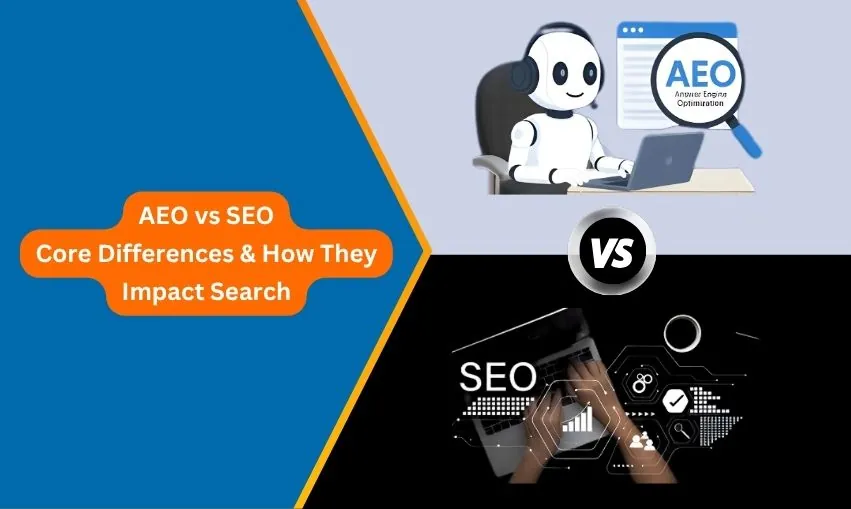
Is ranking on page one still enough to keep your business visible in 2026? For a long time, the answer was simple: optimize for search engines, climb the rankings, and the traffic follows. But search is no longer what it used to be. The rise of AI-powered platforms has introduced an entirely new layer of competition, one where AEO vs SEO is becoming the defining conversation in digital marketing.
In fact, according to Gartner (in 2024), traditional search engine volume is projected to drop 25% by 2026 as users migrate to AI chatbots and virtual assistants. Fast forward to 2026, roughly 60% of US searches already end without a single click. The answer appears directly on the results page before the user ever visits a website. If your current strategy is built purely around rankings and clicks, a growing portion of your potential audience is simply bypassing you altogether.
If you rely on organic search visibility, you need to learn the difference between AEO and SEO and how to align both to stay ahead of the game. So, how to build a strategy that actually works with both disciplines? Let’s find out.

See How Our Experts Can Drive More Traffic to Your Website!
SEO: Boost your rankings and drive more organic traffic today!
Website Design/Development: Create a stunning website that converts visitors into customers.
Paid Media: Reach the right audience at the right time with expertly managed paid media.
What Is SEO?
Search Engine Optimization has defined digital marketing for two decades — but its role is now changing.
Search Engine Optimization (SEO) is the practice of improving a website’s visibility in traditional search engine results pages (SERPs), primarily on Google. The goal is to rank higher for relevant keywords so that users searching for those terms click through to your site.
The core pillars of SEO remain consistent:
- Technical performance (site speed, crawlability, mobile optimization)
- On-page content (keyword relevance, structure, depth), and
- Off-page authority (backlinks, brand mentions, domain credibility).
A well-executed SEO strategy drives consistent organic traffic, builds long-term visibility, and delivers leads at a fraction of paid advertising costs. But SEO was designed for a world where users interact with a list of ranked links. That world is changing fast, and that is where AEO enters the picture.
What Is AEO?
AEO is the process of making your content the answer AI systems choose to show on the surface, not just one of many results to scroll through.
Answer engine optimization (AEO) is the practice of structuring content. It helps the AI-powered platforms and voice assistants extract, trust, and deliver it as a direct answer to a user’s question. When SEO earns you a position on a results page, answer engine optimization earns you the answer itself.
The change is due to the fundamental behavioral shift in users. Instead of typing a keyword and scanning a list of results, today’s users ask natural-language questions and expect a complete response. AI systems scan the web, assess the sources for clarity, and construct an answer often citing two or three sources in the process. If your content is not structured for such extraction, it will not be a fit for AEO, even if your page ranks top in SERPs.
But keep in mind that AEO does not replace SEO. It functions as the next layer of visibility. SEO gets your content discovered and indexed. AEO determines whether that content is then selected, cited, and delivered as the trusted answer or an AI-generated response.
AEO vs SEO: What’s the Real Difference?
Not sure which one your business needs? Here’s a quick side-by-side look
| Factor | SEO | AEO |
|---|---|---|
| Full form | Search Engine Optimization | Answer Engine Optimization |
| Main goal | Get clicks to your website | Give a direct answer, right away |
| Where it works | Google and other top SERPs | AI tools, Voice search, Featured snippets |
| What it targets | Keywords and search rankings | Questions people actually ask |
| Content style | Long-form blogs, Landing pages | Short, clear, direct answers |
| Best content types | Guides, blogs, product pages | FAQs, how-tos, and definition sections |
What an Effective AEO Strategy Looks Like
AEO is not a separate content track. In fact, AEO is layered on top of your existing SEO foundation.
If you wish to create an effective AEO strategy, you need to be aware of how AI systems are using your content. These AI systems are not using vague or over-optimized content. These systems use authoritative, well-organized sources that directly address user intent. Here is what effective AEO optimization looks like:
- Answer-First Content Structure: Each section needs to have a 40-60-word direct answer within the first section. This is because AI systems are using the first lines of a section to get the content, not diving deeper into the content.
- Question-Based Headings: Using question headings for your H2S and H3S allows you to frame the actual questions that AI queries are using within your content.
- Schema markup implementation: The FAQ page, HowTo, and article schema provide explicit information to the AI crawlers about the structure of your content. The schema is the instruction manual for the AI crawlers that tells them what your content is actually about.
- Entity clarity and consistency: Make sure your brand name, your products, and your subject matter are clearly stated across your website and other third-party sources. The AI crawlers understand entities through pattern recognition across multiple references.
- Third-party authority building: Brands are 6.5 times more likely to be mentioned in AI crawlers through third-party sources than through their own domain. The more your brand is mentioned in third-party publications, podcasts, and review websites, the more likely your brand is to be seen in the AI crawlers.
- Conversational FAQ sections: Creating dedicated content for FAQs that matches the exact questions asked to voice assistants and other AI chatbots is one of the most powerful AEO assets that every business can create.
Why the Difference Between AEO and SEO Matters in 2026
The SEO vs AEO comparison is not academic. It has direct revenue implications for businesses across every industry. Suppose a customer asks an AI assistant for the best accounting software for small businesses, or the top-rated HVAC service in Austin. If your brand is not in the AI’s answer, you have effectively lost that customer before the buying decision even begins.
According to Acquia’s 2025 survey, 70% of US marketers believe AEO will significantly impact their digital strategy. Yet only 20% have begun implementation. Here’s why both SEO and AEO optimization matter in 2026:
- Discovery is moving further upstream: An increasing percentage of purchase decisions are being made within AI conversations before users even arrive at a brand’s website.
- Zero-click is the new normal: 60% of searches ending without a click means that an SEO-only strategy is only reaching a shrinking percentage of total searches.
- Citations are the new rankings: Being cited by an AI as a trusted source is equivalent to what a number one ranking in Google was five years ago.
- Trust is transferred differently: When users are directed to a brand’s website because they were cited by an AI, they arrive with more trust transferred to that brand than users who click on an organic listing in Google.
SEO and AEO: Why You Cannot Choose Just One
The most effective digital presence in 2026 will require SEO as a foundation and AEO as a next level of visibility.
The distinction between answer engine optimization and SEO can be misleading. These two concepts are not competitive, but complementary. SEO and AEO have to be done in parallel, not sequentially. A strong domain authority, fast technical performance, strong backlinks, and well-organized content are essential for traditional search rankings and AI citation.
AI does not exist independently of traditional search. Google’s AI Overviews, for instance, are based on sources that are already ranking well on traditional search. This means that your SEO foundation will directly influence your AEO potential. AEO cannot exist without a foundation of SEO. On the other hand, without AEO optimization, your well-optimized content may be ignored in favour of sources that are better optimized for AI.
AEO and SEO for Modern Search: Building a Unified Strategy
If you treat AEO as an add-on, then your brand will fall behind. You need to integrate it into your core content, SEO, and AEO marketing operations. Here’s how you should approach AEO and SEO for modern search in 2026:
| Phase | SEO Focus | AEO Focus |
|---|---|---|
| Foundation | Technical audit Crawlability Core Web Vitals |
Schema markup Structured data Semantic HTML |
| Content | Keyword research Long-form depth E-E-A-T signals |
Answer-first structure Question-based headings FAQ blocks |
| Authority | Backlink acquisition Digital PR |
Third-party citations Brand mentions across AI-indexed sources |
| Measurement | Rankings Traffic CTR via Search Console |
AI citation tracking Brand mention monitoring AI referral traffic |
You can also consider working with a professional SEO agency that knows what AI search optimization is all about. Their AI digital marketing services can provide your businesses with a single strategy that combines both technical SEO execution and content engineering for AEO.
The Future of Search Requires Both SEO and AEO
The answer engine optimization vs SEO ultimately points to one conclusion: the businesses that win visibility in 2026 will be those that treat search optimization as a dual discipline. Answer engine optimization does not exclude SEO. Conversely, it extends it into the AI layer of search, where users are beginning to rely on direct answers. SEO gets you found. AEO gets you quoted. The smartest content strategy today uses both.
Learn the difference between AEO and SEO, to build a brand that maintains organic relevance from those that quietly lose market presence as search continues to evolve.
Want to upgrade your brand for long-term visibility across both traditional and AI-powered search. Connect with our team to explore how our AEO services can be tailored to your business goals and industry.


